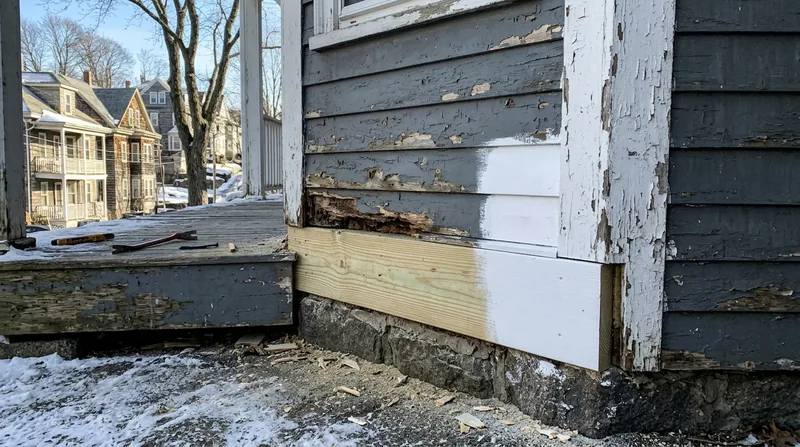




Wood Rot & Dry Rot Repair in Worcester starts with snow. The city sits at 500 to 1,000 feet in central Massachusetts, catching nor'easters, ice dams, and heavy freeze-thaw cycles that soak the lowest boards of every home. Fascia, sills, triple-decker porches, and the bottom siding courses stay wet through winter and spring. We cut out the rot, treat what remains, and rebuild with rot-resistant lumber. A lasting repair, not a cosmetic patch. Worcester Carpentry has been doing this work since 2016, and we know exactly where the water goes on these hills.
Why Wood Rot Matters in Worcester: The Ice Dam and Snowmelt Story
Worcester's winter climate is unforgiving to wood. Ice dams trap meltwater against fascia and rim joists. Nor'easters drive rain sideways into siding and trim. The freeze-thaw cycle cracks paint, opens joints, and lets water migrate deep into framing. Carpenter ants and eastern subterranean termites follow the moisture. Wood rot is not a cosmetic issue here; it is a structural timeline. The sooner you address it, the smaller the repair and the lower the cost.
- Ice dams and spring melt are the primary rot drivers on triple-decker porches, fascia, and sills across Grafton Hill, Vernon Hill, and the West Side.
- Freeze-thaw cycles split paint and caulk, allowing water to penetrate framing and sills year after year.
- Rot spreads horizontally along grain and vertically through rim joists, floor joists, and stud framing if left unchecked.
- Early repair stops the damage before it reaches structural members and requires joist replacement or sistering.
Catching rot early keeps your repair bill in the hundreds, not thousands. If you see soft wood, paint failure, or staining on your home's lower courses or porch structure, call us for an estimate.
Key info: Worcester's triple-deckers and Victorians built before 1920 are especially vulnerable. The century-old lumber has lost density, and decades of winter weather have worn protective coatings. We see the most rot on north-facing fascia, porch stringers, and sill plates. Check your home's south and west exposures after ice dams melt, and your north side after heavy snow.
For more on how moisture and wood damage interact in older Worcester homes, see our guide to Termite Damage Repair, which often accompanies water intrusion.
How We Repair Wood Rot: The Process We Use in Worcester Homes
We do not patch rot; we remove it completely and rebuild with sound material. Our process begins with a thorough inspection to find the full extent of damage, often hidden behind paint or trim. We then cut out all compromised wood, treat the remaining sound framing with a wood preservative, and install new rot-resistant lumber (typically pressure-treated Douglas fir or redwood) fitted tight to the existing structure. The work is meticulous because the repair must last as long as the original wood.
- We probe and sound the wood to locate rot that is not visible on the surface, especially in sills and rim joists.
- We cut out all soft, discolored, or compromised wood, creating clean shoulders for the new material to bear against.
- We treat the remaining wood with a preservative and allow it to dry before installing the new section.
- We fit and fasten new lumber with corrosion-resistant fasteners, often scribing the new piece to match the profile of the original trim.
- We prime and paint the repair to match the existing finish and protect against future water intrusion.
This method takes more time than a quick cosmetic fix, but it is the only way to ensure the repair outlasts the season.
Local example: A triple-decker on Grafton Hill had rot in the fascia and soffit where ice dams had backed water up every winter for five years. The sill plate was soft, but the floor framing above it was sound. We removed 18 linear feet of fascia and soffit, treated the rim joist, and installed new redwood fascia and aluminum soffit. Cost was $2,100. Had the owner waited another two years, the rim joist would have needed replacement, and the cost would have doubled.
Related structural repairs often go hand in hand with rot removal. If your rot extends to floor joists or load-bearing members, see Floor Joist & Subfloor Repair for details on sistering and joist replacement.
Wood Rot Repair Methods: Comparing Approaches
| Approach | Description | Best for |
|---|---|---|
| Localized removal and replacement | Cut out the rot, treat the framing, install new lumber matched to the existing profile and species. | Rot confined to fascia, sills, trim, or porch stringers where the underlying framing is sound. |
| Sistering and reinforcement | Install a new joist or beam alongside a damaged member, fastened securely to share the load. | Rot in floor joists or beams where replacement would require excessive demolition or structural support. |
| Full member replacement | Remove the entire damaged joist, beam, or sill plate and install new lumber, often requiring temporary support. | Rot extends through the full depth of a structural member or affects multiple joists in a run. |
| Epoxy injection and stabilization | Inject epoxy into sound wood adjacent to rot to harden and stabilize the remaining structure. | Minor surface rot on trim or casing where the wood is otherwise sound and structural. |
The right method depends on the rot's location, depth, and whether structural members are involved. We assess each job on site and recommend the most cost-effective repair that will last.
Wood Rot & Dry Rot Repair Cost in Worcester: What to Expect
Wood rot repair in Worcester typically starts at $650 for localized rot on fascia, trim, or a short run of sill. Larger repairs, such as replacing multiple feet of rim joist or sistering a floor joist, range from $1,200 to $3,500. Jobs involving full joist replacement or structural members may exceed $5,000 and require an on-site estimate. The cost hinges on how much wood must be removed, whether the underlying framing is sound, and whether the repair is accessible without extensive demolition.
Three factors move the price up or down:
- Extent of rot: A single fascia board costs far less than rot that has migrated into a rim joist or floor framing.
- Accessibility: Rot buried behind siding or in a basement rim joist takes longer to expose and repair than rot on an open porch.
- Structural involvement: If joists or beams are affected, reinforcement or replacement adds labor and material cost.
We recommend getting 2 to 3 estimates so you can compare scope, method, and price. Many homeowners are surprised to learn that a thorough repair costs less than they feared because rot is often smaller than it appears. Visit our pricing page for more detail on how we structure estimates and what factors we assess on site.
Wood Rot & Dry Rot Repair Near Me: What to Look for When Hiring a Carpentry Contractor
Hiring a carpenter for wood rot repair is not the same as hiring a handyman. The repair must be correct the first time, and the carpenter must have the skill to assess what wood is salvageable and what must be removed. When you call a contractor, ask whether they are fully insured, whether they provide a written estimate that describes the scope and materials, and whether they can provide references from recent jobs in Worcester or nearby towns like Grafton, Sutton, or Webster.
A few practical steps will protect your investment:
- Verify that the contractor carries general liability and workers compensation insurance and can provide a current certificate of insurance.
- Ask for an itemized estimate that lists the lumber type, square footage or linear footage of repair, labor hours, and finish materials.
- Request references from three jobs completed in the last two years, and call at least two of them to ask about quality and timeliness.
- Confirm that the contractor understands local building codes and whether your repair requires a permit from the Worcester Building Department.
- Discuss warranty: a reputable carpenter will stand behind the repair for at least one year and often longer.
If your home is historic or subject to a local historic district overlay, check with the Worcester Historical Commission before starting work. Some districts require approval of exterior repairs. For a free estimate and to discuss your specific situation, contact us at (978) 440-1508.
Wood Rot & Dry Rot Repair in Worcester: Pricing Guide
| Service | Price | Details |
|---|---|---|
| Localized fascia or trim rot | Starting at $650 | Surface rot on fascia, soffit, or trim boards up to 8 linear feet, removal and replacement with rot-resistant lumber |
| Porch or sill repair | Starting at $1,200 | Rot in porch stringers, sill plates, or rim joists up to 12 linear feet, including treatment and new pressure-treated lumber |
| Floor joist sistering or minor structural repair | Starting at $2,000 | Reinforcement of one to two joists or partial beam repair, including temporary support, treatment, and fastening |
| Full joist or beam replacement | On estimate | Complete removal and replacement of structural members requires on-site assessment, temporary support engineering, and often a permit |
| Travel | Included | No separate fee for Worcester, Grafton, Sutton, Webster, or West Boylston; mileage included in estimate |
| Free estimate | No obligation | We respond within 24 hours at (978) 440-1508, inspect the damage, and provide a detailed written quote |
Indicative pricing, the exact cost depends on square footage, finish, and site access. Free personalized estimate within 24h at (978) 440-1508.


