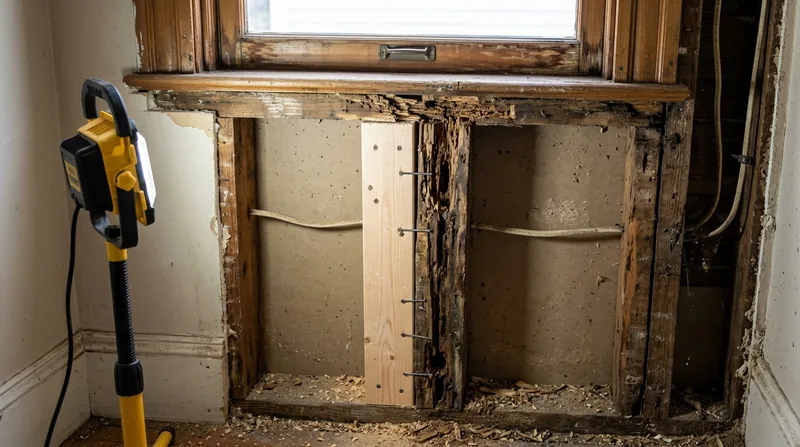




Termite Damage Repair in Worcester requires knowing what you are looking at and acting before the damage spreads through your framing. Eastern subterranean termites and carpenter ants nest in the damp wood around ice-dammed eaves, old triple-decker porches, and foundation sills across Worcester's 1890s-1920s wood-frame neighborhoods on Grafton Hill, Vernon Hill, and Main South. The freeze-thaw winters, heavy snow, and humid summers that define central Massachusetts create the exact moisture conditions these insects need. We identify damaged studs, sills, subfloor and floor joists, replace the compromised wood, and address the moisture problem that drew them in. Ignoring the damage means it spreads quietly through the framing until structural repair becomes expensive and invasive. Our approach is to repair what can be saved and replace what cannot, using field-proven methods and local knowledge of how Worcester's old homes fail.
Why Termite Damage Matters in Worcester's Historic Wood-Frame Homes
Termites and carpenter ants do most of the structural wood damage we see in central Massachusetts. They work silently inside framing, leaving no obvious surface sign until you probe the wood and feel it give. Worcester's triple-deckers, Victorians, colonials, and mid-century homes were all built with solid-sawn framing that these insects find irresistible, especially where moisture has softened the wood. The damage they cause is cumulative and spreads along the grain and through multiple members if left unaddressed. Early detection and repair stop the progression and preserve the structural integrity of your home.
- Termites tunnel through studs, sills, and rim joists, leaving thin shells of wood that crack under load.
- Carpenter ants excavate galleries in damp framing, weakening joists and subfloor before you notice soft spots in the floor.
- Both pests are attracted to moisture from ice dams, failed flashing, and poor drainage around foundations and porches.
- Structural failure can occur in floor systems, load-bearing walls, and exterior framing if damage is left untreated for years.
- Catching damage early and repairing it is far less costly than replacing entire floor systems or wall sections later.
The best defense is moisture control and regular inspection of vulnerable areas, especially in older homes.
Key info: Worcester homeowners often discover termite damage when a floor feels soft near a porch or when probing the rim joist reveals hollow wood. If you have a pest inspection report showing termites or carpenter ants, bring it to us. We work from your inspection findings and replace the damaged wood your pest professional has identified. We do not perform pest treatment or fumigation, that is a separate licensed trade. See the Worcester Board of Health or Massachusetts Department of Agricultural Resources for licensed pest control operators in your area.
How We Repair Termite Damage in Worcester Homes: Step-by-Step Process
Our approach starts with a clear understanding of what the damage is, where it is, and how far it has spread. We work from your pest inspection report and our own probing and visual assessment to map the extent of the problem. We then remove the damaged wood in sections, support the framing above, and sister in new studs or replace sills, joists, and subfloor using pressure-treated or solid-sawn lumber matched to the original framing. We finish by addressing the moisture source, whether that is flashing, drainage, or ventilation. The goal is to restore structural strength without unnecessary replacement.
- Inspect the damage on-site, probe the extent, and document what needs repair using your pest report as a reference.
- Remove damaged wood carefully, section by section, shoring the structure above to keep loads supported throughout the work.
- Install new studs, sills, rim joists, or subfloor using pressure-treated lumber or solid stock matched to the original framing species and dimension.
- Seal cut ends, apply flashing or caulk where needed, and ensure water cannot re-enter the repaired framing.
- Restore any finish surfaces, flooring, or trim that were removed to access the damage, leaving the repair clean and unobtrusive.
This methodical approach means the damage is arrested and the home is stable again, with no guesswork about what remains hidden.
Local example: A Tatnuck colonial with soft spots in the first-floor subfloor near the rim joist revealed termite galleries running 6 feet along the rim and into two floor joists. We removed the damaged rim section, sistered new joists beside the weakened ones, replaced the rim with pressure-treated stock, and improved drainage at the foundation. The floor is now solid, the damage is stopped, and the repair cost far less than replacing the entire subfloor. See our floor joist and subfloor repair page for more on how we handle structural floor work.
Methods and Materials for Termite Damage Repair
| Approach | Description | Best for |
|---|---|---|
| Sister joist installation | New joist bolted alongside a weakened or partially damaged joist to share the load and restore strength. | Joists with damage on one side or partial galleries that do not require complete removal. |
| Rim joist replacement | Removal of the damaged rim and installation of new pressure-treated or solid-sawn rim, often with new blocking and flashing. | Termite or ant damage concentrated in the rim or sill plate, especially in older homes with moisture intrusion. |
| Sill plate repair or replacement | Removal of rotted or termite-damaged sill and installation of new pressure-treated stock, often with improved flashing and drainage. | Damage at the foundation interface where moisture and pests have compromised the connection between frame and masonry. |
| Subfloor replacement | Removal of damaged subfloor decking and installation of new plywood or solid-sawn stock, often with underlayment and moisture barrier. | Widespread termite or ant damage in subfloor, or damage that affects multiple joists and requires structural restoration. |
| Stud replacement in walls | Removal of damaged studs and installation of new studs, often with temporary bracing and restoration of wall sheathing and finish. | Termite or ant galleries in wall framing, especially in exterior walls or load-bearing walls where structural integrity is critical. |
Termite Damage Repair Cost in Worcester: What to Expect
Termite damage repair typically starts at $1,200 for localized damage in a small area, such as a damaged rim joist section or a few feet of subfloor. Costs rise with the extent of the damage, the number of members affected, and whether the work requires temporary shoring or floor access from below. A full rim joist replacement on a 30-foot perimeter might run $3,000 to $5,000, while subfloor repair affecting multiple joists can exceed $6,000 depending on square footage and structural complexity. The best way to understand your specific cost is to have us inspect the damage and give you a detailed estimate. We recommend getting 2 to 3 estimates from local carpenters so you can compare scope, materials, and timeline. See our pricing page for a full breakdown of service costs and factors that affect the final bill.
Key factors that affect cost include:
- Extent of damage: small localized repairs cost less than damage spanning multiple joists or wall sections.
- Access: damage in crawl spaces or under porches may require temporary shoring or additional labor to reach the wood safely.
- Material choice: pressure-treated lumber costs less than solid-sawn or specialty species, but all are durable and code-compliant for repair.
- Finish work: restoring flooring, trim, or wall surfaces after the structural repair adds to the total, but ensures a clean final result.
- Moisture remediation: if flashing, drainage, or ventilation must be improved to prevent recurrence, that is included in the scope and cost.
Addressing termite damage promptly stops the spread and keeps repair costs lower than waiting until the damage is widespread.
Hiring a Carpenter for Termite Damage Repair Near Me: What Worcester Homeowners Should Know
Choosing the right carpenter for termite damage repair means finding someone who understands Worcester's old homes, can read the damage accurately, and knows how to repair without over-replacing. Look for a fully insured contractor with a track record in residential framing and wood repair. Ask for references from past clients in your neighborhood, check online reviews, and request an itemized estimate that explains what will be removed, what will be replaced, and why. Verify that your contractor understands any permit requirements for structural work in your city. Worcester building codes may require a permit for certain repairs, especially if the work affects a load-bearing wall or alters the floor system. Call the Worcester Building Department to confirm before work begins. If your home is in a historic district or subject to HOA rules, check those requirements as well.
A good estimate will address the moisture source, not just the wood. If your carpenter only proposes replacing the damaged wood without fixing the leak or drainage that caused the damage, you will likely see the problem return. We recommend getting your own pest inspection report before soliciting repair estimates, so each contractor is working from the same damage assessment. Call us at (978) 440-1508 for a free estimate, or visit our contact page to request an on-site inspection and detailed proposal.
Termite Damage Repair in Worcester: Pricing Guide
| Service | Price | Details |
|---|---|---|
| Small localized repair (rim joist section, limited subfloor) | Starting at $1,200 | Includes removal of damaged wood, installation of new members, flashing, and finish restoration for single-area damage. |
| Medium repair (multiple joists, larger rim section, or wall studs) | Starting at $3,500 | Covers sistering or replacement of multiple structural members, temporary shoring, moisture remediation, and finish work. |
| Large-scale repair (extensive subfloor, full rim replacement, or multiple wall sections) | Starting at $6,000 | Comprehensive structural restoration including temporary support, new framing, flashing, drainage improvement, and finish restoration. |
| Estimate and site inspection | Free | We inspect the damage, probe the extent, document findings, and provide a detailed written estimate within 24 hours. |
| Travel and service areas | Included | No separate charge for Worcester, Grafton, Sutton, Webster, West Boylston, and surrounding central Massachusetts communities. |
Indicative pricing, the exact cost depends on square footage, finish, and site access. Free personalized estimate within 24h at (978) 440-1508.


